Enter password to view

Coupa

Supplier Team Leadership

Supplier AI Agent Transformation

Unleashing AI Agents from the inside out

April 15, 2026 90 minutes

Agenda

What we'll cover

01 Agent Patterns
02 Claude Code — Live
03 Agentic Workflows — Analytics
04 The Supplier Agent Platform
05 Discussion + Next Steps
01
Coupa

Section One

AI Workflow and Agent Patterns

Overview & Fundamentals

Pattern

Augmented LLM

An LLM enhanced with retrieval, tools, and memory — the fundamental building block
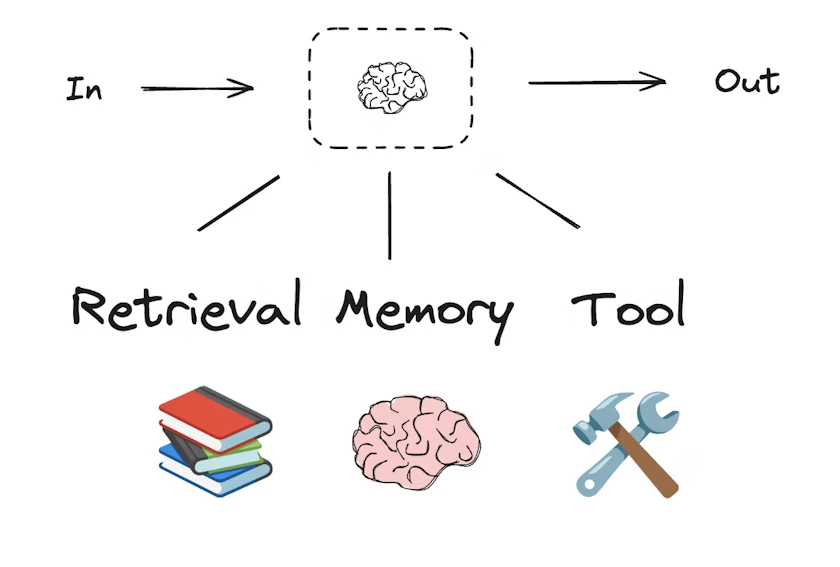
Augmented LLM architecture diagram showing retrieval, tools, and memory connected to a central LLM
Coupa Example

Chatbot answering supplier questions by looking up CSP account data in real time

Pattern

Prompt Chaining

Break complex work into sequential steps with validation gates between each
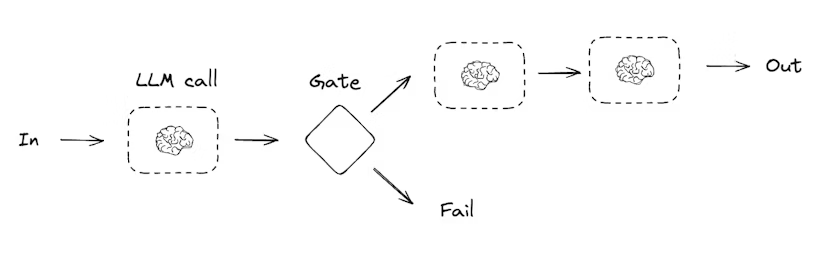
Prompt chaining architecture showing sequential LLM calls with gate checks between steps
Coupa Example

Invoice extraction: parse document → match to POs → enrich with master data → submit

Pattern

Routing

Classify the request, route to the right specialist — right expert, right problem
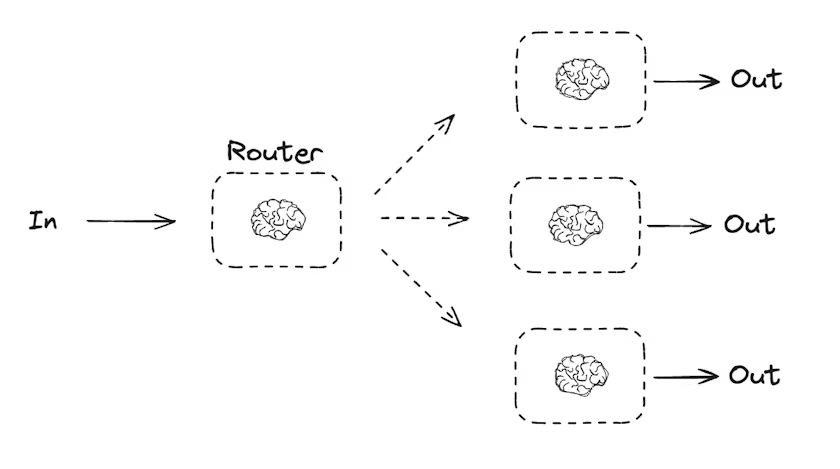
Routing architecture showing a classifier directing requests to specialized model handlers
Coupa Example

Navi Global Buyer Agent: Analytics vs. Sourcing vs. Document Retrieval vs. General BSM

Pattern

Agent

An autonomous system that reasons, acts, and adapts on its own — no script, just a goal
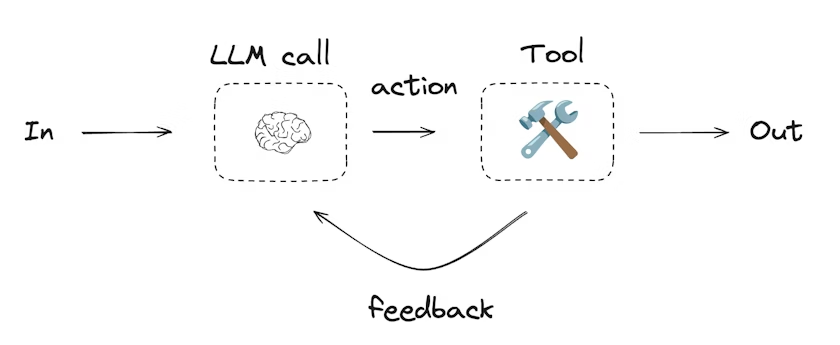
Agent architecture showing an autonomous loop of reasoning, acting, and observing
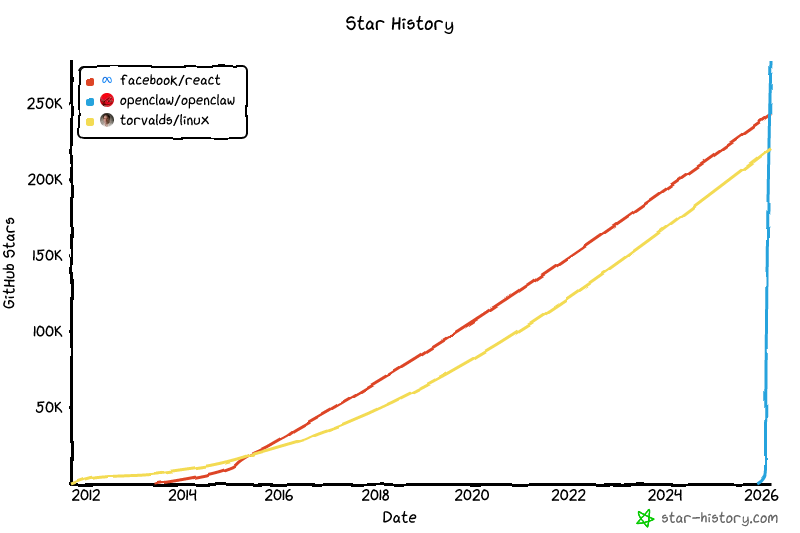
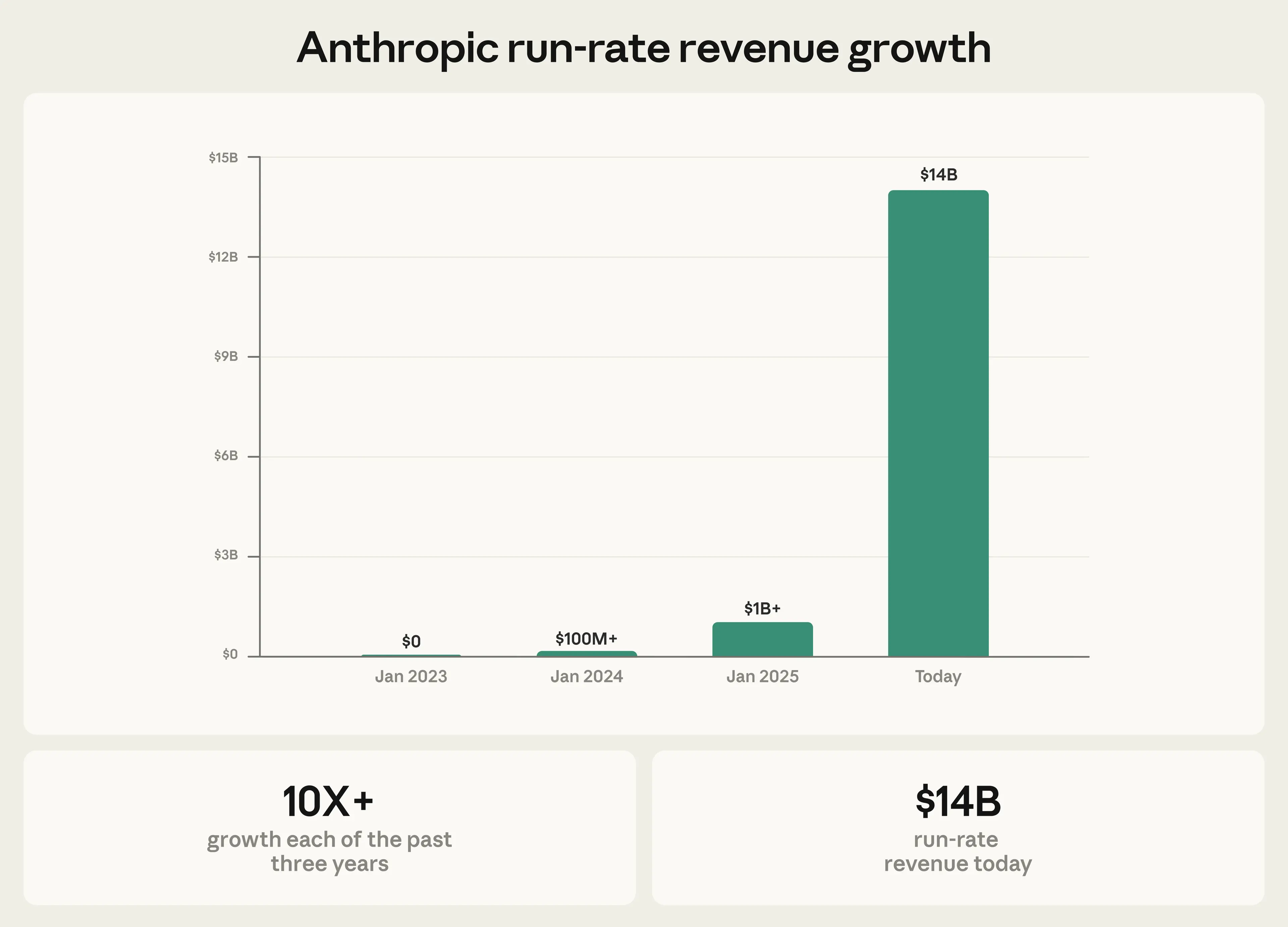
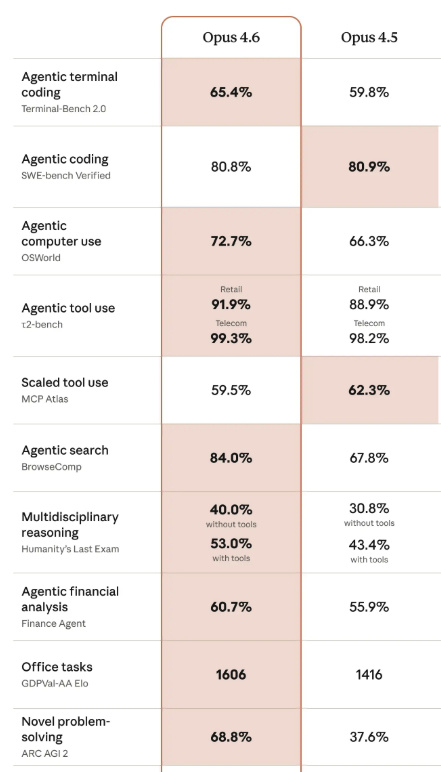
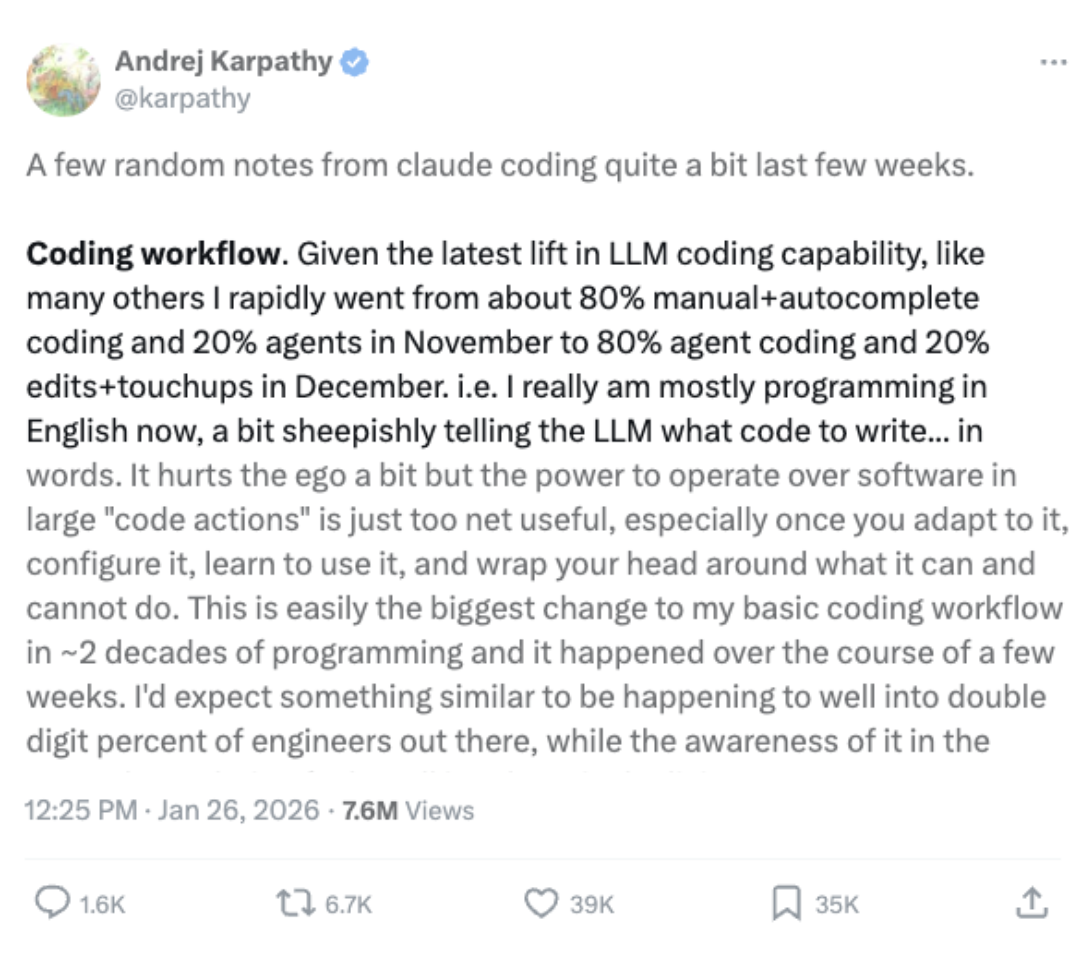
OpenClaw GitHub stars surpassing React and Linux Anthropic run-rate revenue growth to $14B Opus 4.6 vs 4.5 agentic benchmark comparison Andrej Karpathy on coding workflow shift to 80% agent

Inflection Point

In the last  ~120 days, coding agents crossed a reliability threshold: benchmark scores jumped, terminal autonomy improved sharply, and the category became commercially consequential.

Pattern

The Agent Harness

One architecture powers Claude Code, Codex, OpenClaw, Cursor — reason, act, observe, repeat
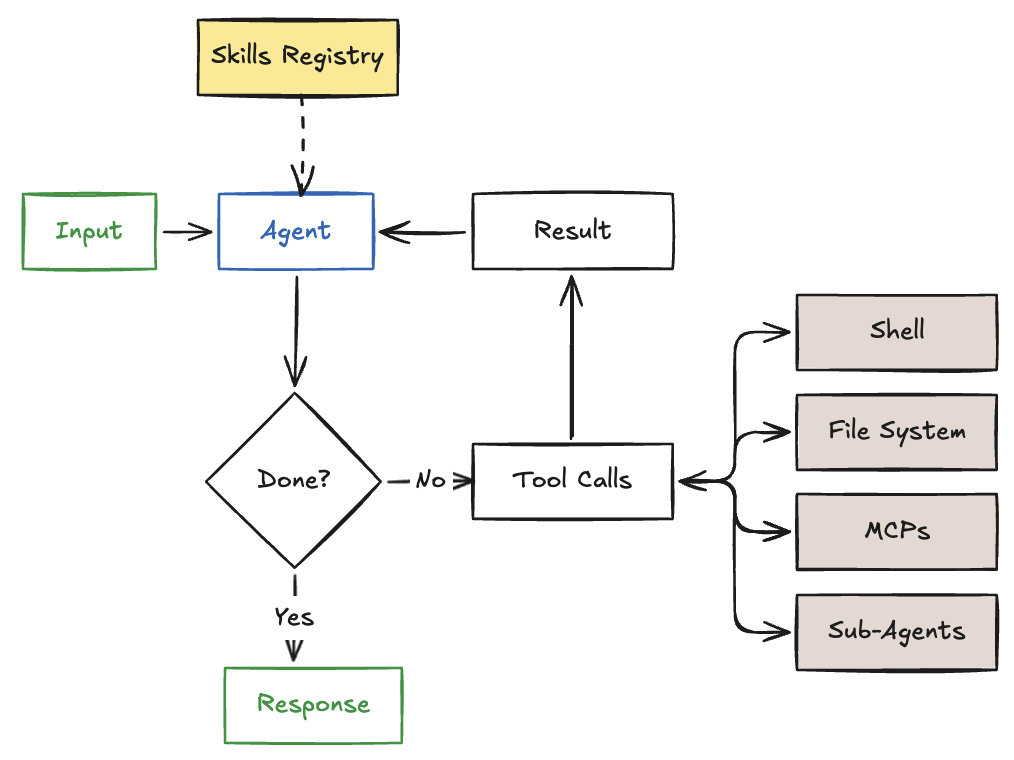
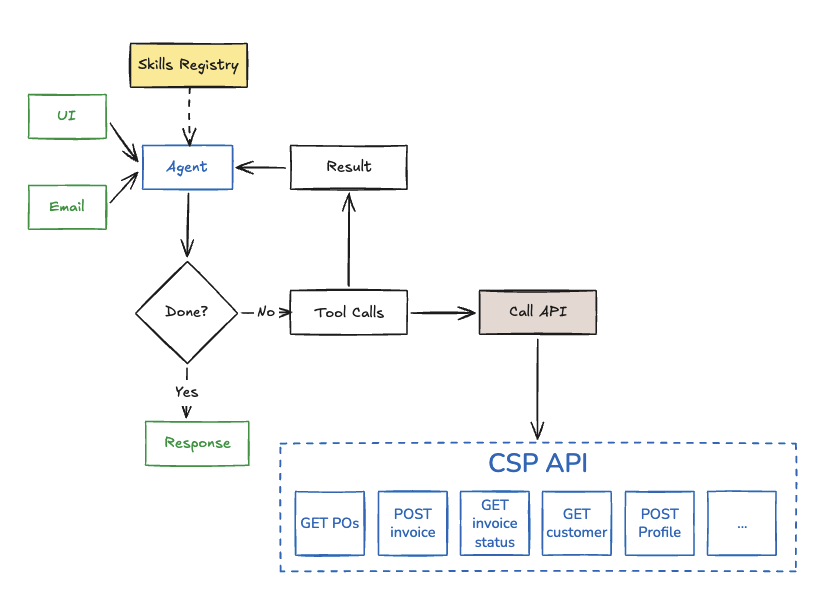
The canonical agent loop: input flows to agent with skills registry, agent reasons and makes tool calls to shell, file system, MCPs, and sub-agents, observes results, and repeats until done

Deep Dive

Skills as Files

A markdown file, a folder of references, and the agent learns a new capability at runtime

File System
.claude/skills/
├── analysis/
├── expert-system/
├── init-project/
├── metabase-query/
│   ├── SKILL.md
│   ├── references/
│   │   ├── semantic-layer.md
│   │   └── semantic-layer-appendix.md
│   └── scripts/
│       └── metabase-query.sh
├── pendo-query/
├── pr-cleanup/
├── pr-description/
├── skill-creator/
└── vault-ops/
SKILL.md — metabase-query
---
name: metabase-query
description: >
  Generate and run SQL queries against the Coupa Presto data warehouse via Metabase. Use when the user asks data questions, references database tables, wants to run queries, asks about supplier analytics, invoices, purchase orders, CSP accounts, CoupaPay, sourcing...
---

You are a Coupa data analyst. You generate accurate Presto SQL using a semantic layer that encodes institutional knowledge about the Coupa data warehouse — table relationships, join patterns, business logic, and metric definitions.

## How This Skill Works

1. User asks a data question (natural language or SQL)
2. Read the semantic layer reference to identify the right tables, joins, and filters
3. Generate Presto SQL and show it to the user
4. If the user confirms, execute via the Metabase script

## References

Always read first:
  references/semantic-layer.md — Core reference. Contains Presto dialect rules, multi-tenancy hashing, all 12 entity definitions, 20+ metric formulas, dimensions, join paths, and 5 annotated examples. Read this before generating any query.

Read on demand:
  references/semantic-layer-appendix.md — Verbose business logic blocks. Invoice cost weights, savings projections, SPA ranking, payment terms parsing (80+ line CASE WHEN block), cross-border spend detection, supplier engagement thresholds...
System Prompt
# The following skills are available:

- analysis: End-to-end analytics workflow: intake a question, research context, plan the analysis, run queries, and publish to the Confluence Insights Archive.

- expert-system: Search a curated repository of recent research and insights about business, AI development, economics, and strategy.

- init-project: Scaffold a new project from a golden template, create a GitHub repo, write CLAUDE.md, and deploy to Vercel.

- metabase-query: Generate and run SQL queries against the Coupa Presto data warehouse via Metabase. Use when the user asks data questions, references database tables, wants to run queries, asks about supplier analytics, invoices, purchase orders...

- pendo-query: Query Pendo analytics data using natural language. Use when the user asks about page views, feature usage, visitor activity, or traffic.

- pr-cleanup: Find and remove unused code on the current branch before merging.

- pr-description: Create clear, concise pull request descriptions from branch diffs and recent commits.

- skill-creator: Create new skills, modify existing skills, and measure skill performance.

- vault-ops: Manage Spencer's notes system end-to-end. Use when adding to, reading from, or organizing notes and knowledge base.

Under the Hood

Context In, Action Out
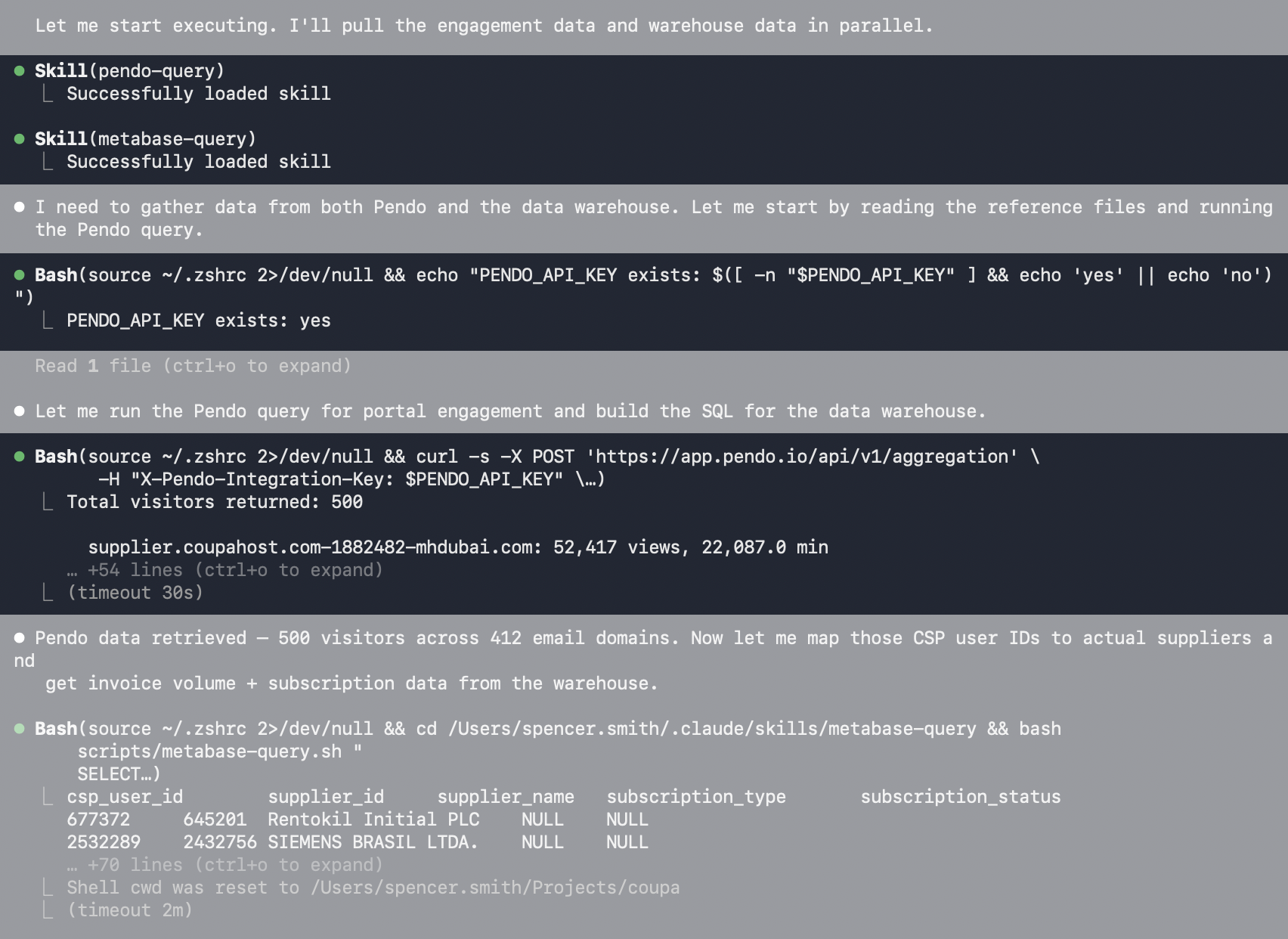
The canonical agent loop: input flows to agent with skills registry, agent reasons and makes tool calls to shell, file system, MCPs, and sub-agents, observes results, and repeats until done Tool use pattern: the agent selects and invokes tools, receives structured results, and incorporates them into its reasoning
02
Coupa

Section Two

Claude Code Demo

Live Demos

03
Coupa

Section Three

Building Agentic Workflows

Insights Distillery — Supplier Analytics

Thesis

Two primitives.

Context

what it knows

Tools

what it can do

Primitive

Context

what it knows

Skills Schemas Documentation

Primitive

Tools

what it can do

Read Write Act

start read-only

Framework

Build an agentic workflow

1
Find the job Repetitive, expert-adjacent work where the bottleneck is throughput, not judgment
2
Wire the context What knowledge, schemas, and conventions does the agent need?
3
Grant the tools What reads and writes unlock the job? Start read-only
4
Close the loop Who reviews, and how does feedback sharpen context and tools over time?

Case Study

Insights Distillery — Agentic Analytics

The same four steps, applied

Job

Weekly high-volume analytics questions drowning the analyst team

Context

Metabase semantic layer → skill; Pendo schema → skill; analysis templates; past queries

Tools

SQL against Metabase, Pendo API, Jupyter for reproducibility, Confluence for docs

Loop

Analysts refine skills → PMs distill for business relevance → Execs distill for strategic impact

Deep Dive

Human Gates

Where human judgment enters the workflow

Intake
Gate 1
Research
Gate 2
Plan
Gate 3
Execute
Review
Gate 4
Publish
Gate 1
Confirm the Question

Validate that we’re answering the right question for the right stakeholder

Gate 2
Resolve Unknowns

Address open questions in the data and provide additional domain context

Gate 3
Approve the Approach

Sign off on metric definitions, time periods, and comparisons before execution

Gate 4
Review the Findings

Scrutinize surprising or low-confidence results before they reach the archive

What’s your team’s
context?
What are their
tools?

04
Coupa

Section Four

The Supplier Agent Platform

Constrained to Autonomous

Constrained

The harness does the thinking.
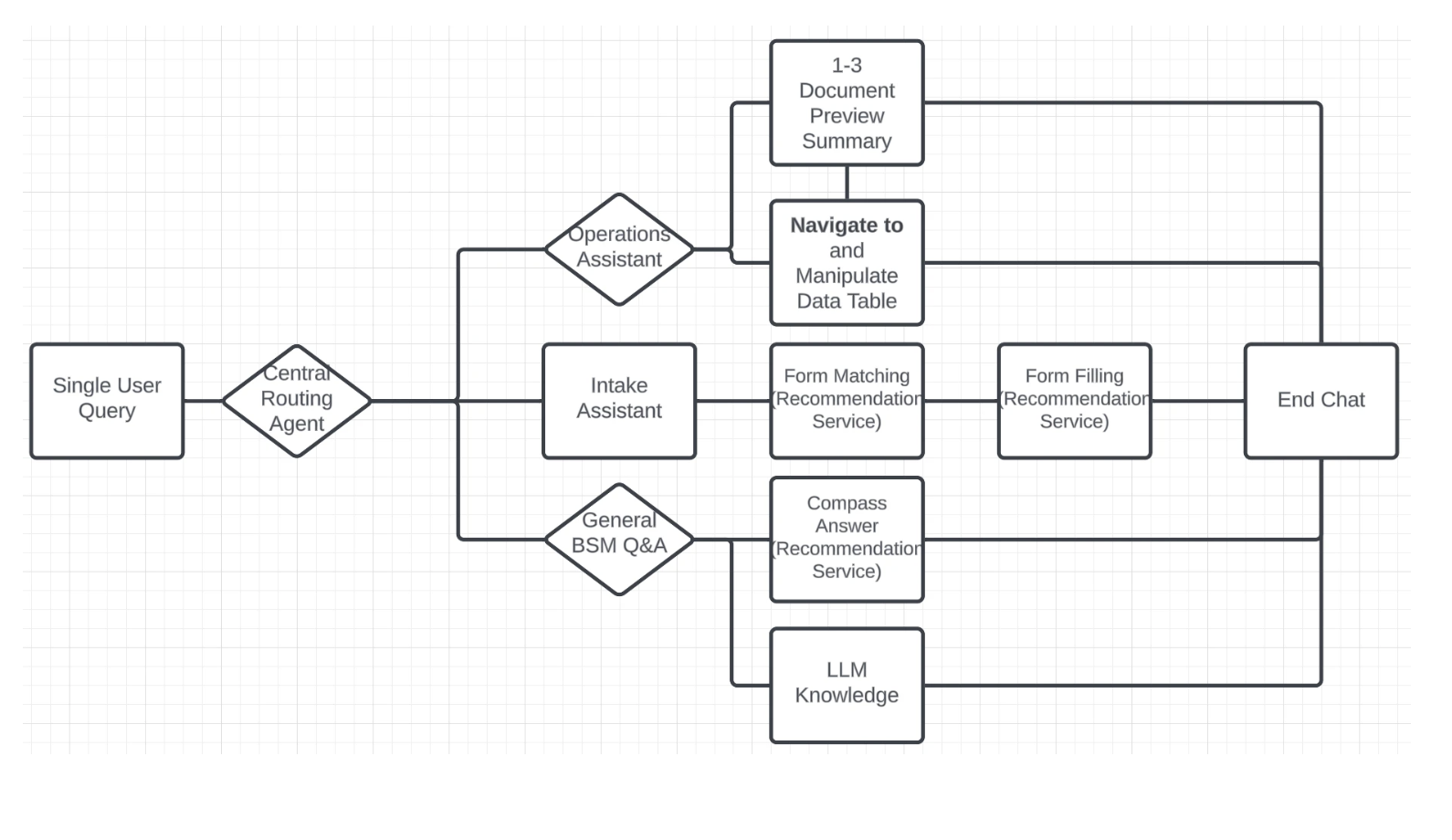
Navi routing architecture: classifier dispatches to hardcoded specialist paths

Autonomous

The model does the thinking.
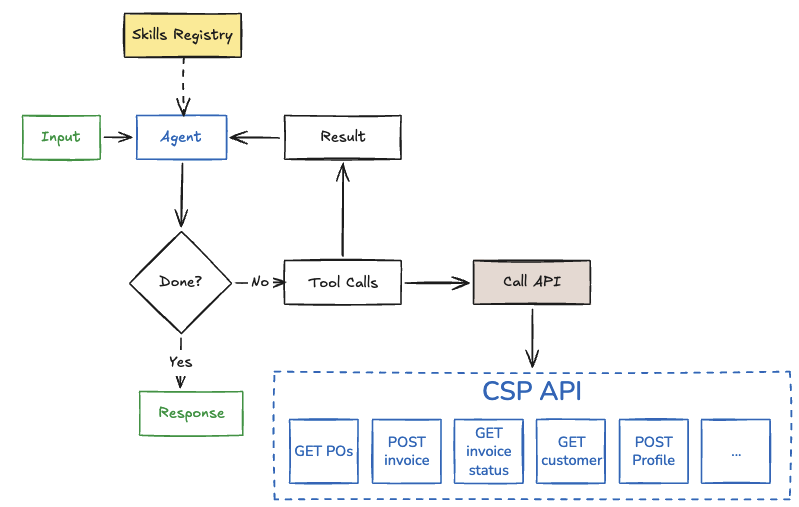
Autonomous agent loop with skills registry making tool calls against CSP API endpoints

Arbitrary Input

The interface becomes irrelevant.
Agent receiving input from UI, email, and other channels — all converging on the same CSP API layer

Headless Future

Agents need APIs, not screens.
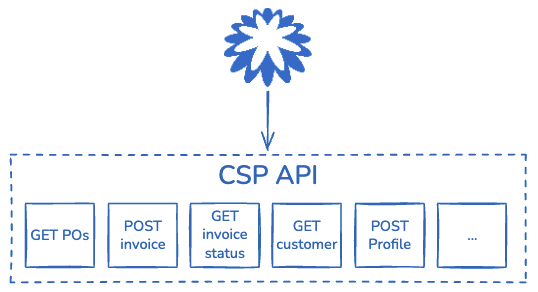
Single agent connecting to CSP API layer with GET and POST endpoints

End State

Their agents. Our platform.
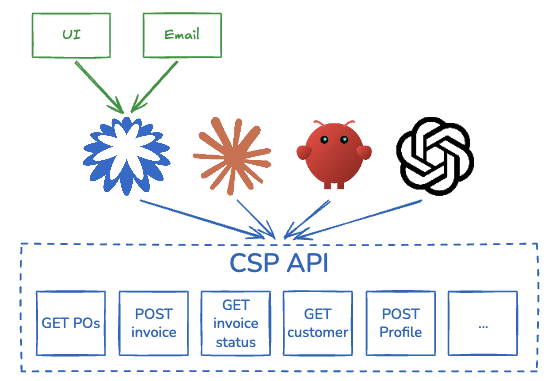
Supplier enterprise agents from multiple providers consuming CSP APIs in a headless interface
Coupa

Discussion

What problems can agents solve for suppliers?

Recap

The Mental Model

1
Agent as architecture Not a marketing term — it’s a loop
2
Context management Skills, progressive disclosure, right knowledge at the right time
3
Tools Giving agents the ability to read and act
4
Human gates Calibrate trust — design where humans enter the loop
5
Agent-first interfaces Agents are a new persona we must build for

Call to Action

Three Asks

1
Use Agents (Claude Code) Start using it this week
2
Route analytics through the Distillery Insight Requests intake
3
Think in APIs Every feature you build is an interface an agent will use